Jesters of yesteryear (A surprising take on Bach’s St. John’s Passion)
I’m stuck. I experienced something incredible and want to tell you about it. But there’s so much prejudice around this subject, the idea feels futile before I even begin. I don’t know where to start.
It’s an impossible task, yet I’m yearning to share it because just days ago I too was prejudiced, and this experience completely undermined my opinion on matters that had seemed obvious. It left me feeling uncomfortable for having had my unquestionable convictions shattered – but also grateful, because I discovered something new and miraculously beautiful.
And, since I cannot explain it from the top, let’s start at the end. Imagine “Zerfliesse”, one of the many beloved arias of Bach’s St. John’s Passion, and imagine it as being performed by musicians of exquisite sensitivity. Now, take this music and imagine that it is accompanied by the most appropriate and refined form of physical movement. It is artful, full of grace, tastefully reflecting both the nuances of the composition and the deeper meaning conveyed by the verses and their context. Now, imagine that these artists portraying Bach’s aria through their movement are circus acrobats – circus acrobats that are conveying exactly that level of depth, emotionality and professionalism that I have invited you to imagine.
In short, what I am trying to say is that an acrobatic ensemble performing a choreography set to a monumental piece by Bach stole my heart. I’m trying to maintain the sober voice of an early music professional, whilst also explaining that I was very touched by circus performers, without sounding crazy.
To say that it’s baffling is to say nothing. Hours before the performance, I was still wondering if it was not a mistake on my part to trust the recommendation of the musician that had encouraged me to attend this concert as being a “must see” (my doubt being fed not least by the fact that I merely know this musician by reputation, and have not met them). Hesitantly, I followed their advice. What I witnessed was breathtaking and I am so glad I could see this unique performance.
***
Now that I think about this performance, what comes first to mind is the famous 1862 painting by Jan Matejko. Known as “Stańczyk”, its full title is Stańczyk during a ball at the court of Queen Bona in the face of the lost Smolensk. It portrays a court jester in an incongruous position of defeat and hopelessness: thoughtfully reclining on an armchair as he takes in the gruesome news of war-time loss. He is surrounded by dark colours, and the abundance of thick fabrics and curtains hanging about create the impression of stillness and silence, as if they were there to muffle any sound disturbing the jester’s grim contemplation.
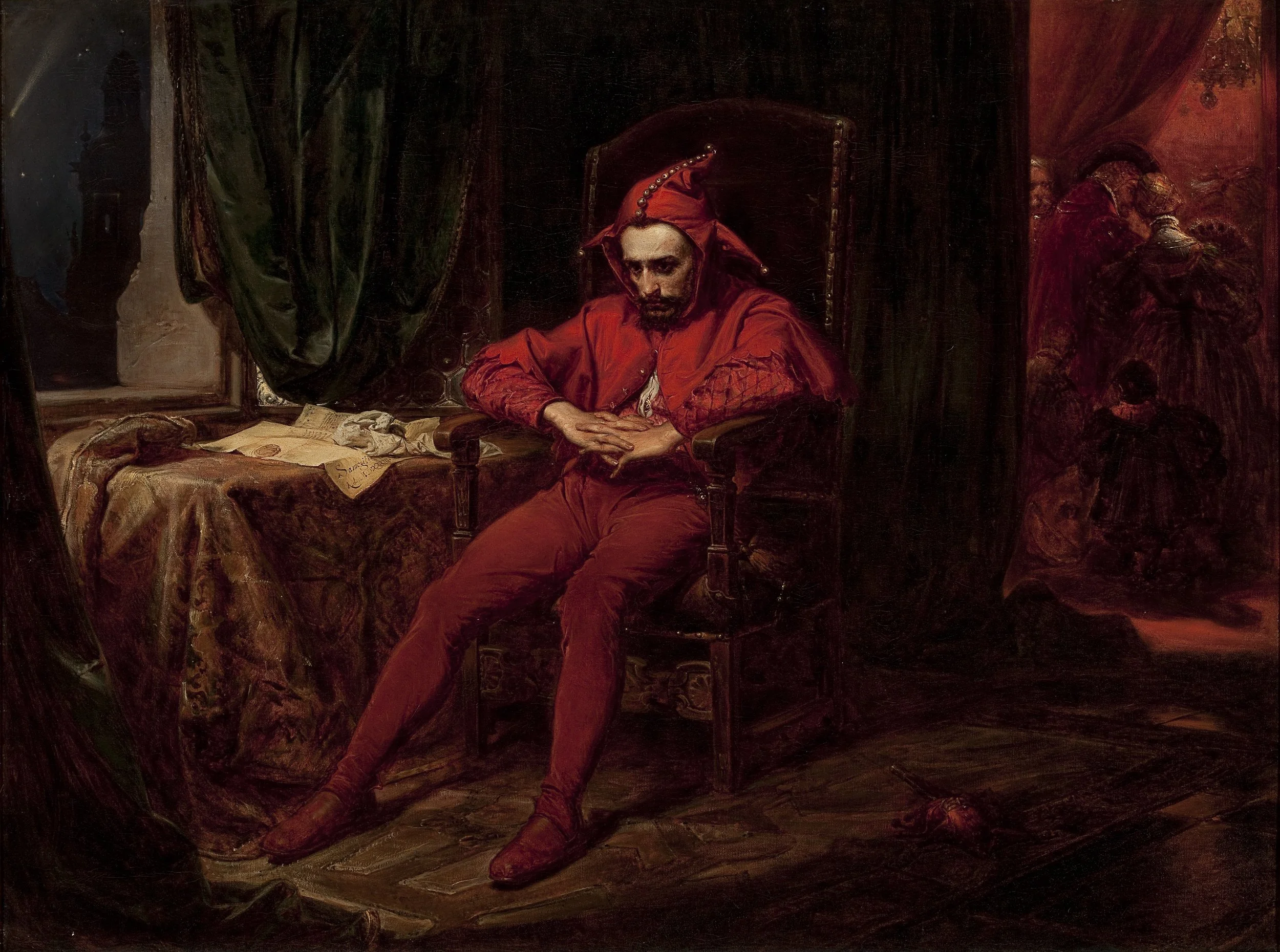
Jan Matejko, Stańczyk during a ball at the court of Queen Bona in the face of the loss of Smolensk, 1862
I believe that the painting owes its recognition and popularity to the stark contrast between subject and context that it displays. When viewing it, the eye is immediately caught by the jester’s bright attire, which makes him a very characteristic figure. However, it takes but a moment to gain a far more nuanced understanding, and one that is striking for its unlikeliness. The jester’s court role and his portrayed emotional state are so vastly separate from each other that the expression of the painting escapes simple categorisation. It defies the viewer’s expectation and in turn, challenges them to think – and indeed, to feel – outside the box.
***
I believe that the performance of the Bach passion with circus acrobats had a very similar effect on me. I’m not sure what I expected, but it definitely was not what I saw. Within minutes of the beginning of the spectacle, I understood and witnessed the depth and range of emotional representation and philosophical exploration of the musical work’s meaning, as performed by the small ensemble of acrobats. It startled me to see that a religious work from 300 years ago could be made so relevant today, even when applied to matters beyond any religious context. I was captivated to see the crucifixion reenacted in such a way as to reflect other events surrounding Christ’s passion as well that were beyond the scope of Bach’s work. I was enchanted by the unspeakable musicality and grace of a juggler matching an aria in a ternary metre with his playful performance with three little balls, vividly portraying all nuances of phrasing, dynamics and articulation of the music.
These acrobats truly understood both early music, and the multifaceted depth of subjects such as pain, loss, death, betrayal, and conformism in the face of evil. I could hardly believe what I saw, because it was so different from what I expected of a circus act that such an experience was almost unthinkable.
And when it was over and the roar of the standing ovation finally calmed down, I was surrounded by fading sunlight and silence in an emptying industrial hall, where a couple of athletes were accepting the last few words of congratulations and tidying up the stage props, as if nothing happened. Yet I knew that something had changed in me. For a while still I sat on the little chair, hardly able to breathe or move, afraid to spoil the magic of this experience. Like a child who can’t figure out the logic behind a magic trick they just saw. Perhaps this is what Jesus meant that to enter Heaven, we need to be like children: to allow ourselves some childlike curiosity and be rewarded with experiencing wonder beyond compare.
Or maybe it was magic. A form of witchcraft, wherein a solemn group of people actually enchanted everyone with their unpredictable choreographies of inhumane force and skill. I can’t tell. I only know that I haven’t been able to stop thinking about it ever since, and that if I ever get the chance to see them perform again, I sure as hell will.
******
For the curious, the performance in question was the spectacle “In Your Hands” performed on 14.05.2026 at the Bachfest Schaffhausen festival in Switzerland, featuring the musicians of the B’Rock Orchestra and Kalle Kalima, and the acrobats’ ensemble from the Tall Tales Company.
https://talltales.nl/en/company/
https://www.bachfest.ch/en/programme